
 719-661-5310
The snow melts off in spring and there it is. Little trails chewed through the lawn. Dirt piles out by the aspens. A shrub that looked fine in October now has its bark nibbled off near the ground.
Or maybe it’s nothing outside at all, just droppings in a kitchen drawer. Three different culprits get blamed for all of this: mice, voles and pocket gophers, and they don’t behave alike, so figuring out which one you’ve got is step one.
Here’s how to tell them apart without ever actually seeing the animal, which, with gophers especially, you probably won’t.
Quick comparison
Mice vs Voles vs Gophers
| Mice | Voles | Pocket gophers | |
| Where you find signs | Inside the house, garage, sheds | Lawn and garden surface | Underground, lawn and beds |
| Main clue | Droppings, gnawing, nests | 1 to 2 inch runways, open holes | Fan-shaped dirt mounds, no open hole |
| Plant damage | Not usually the cause | Bark chewed off trunks and shrubs | Roots cut, plants wilt suddenly |
| Worst time | Whenever they get inside | Winter under snow | Shows up big after snowmelt |
| Seen above ground? | Sometimes | Sometimes | Rarely |
How can you tell if voles are in your yard?
Start with the lawn. Walk it slowly, right after the snow’s gone, and look for skinny paths, maybe an inch or two wide, chewed down through the flattened grass. Squiggly. Kind of like a toddler drew on your yard with a weed whacker. Every so often there’ll be an open hole, about that same size. Step off the path and the ground might feel a little soft and spongy underfoot. That’s the picture Colorado State University Extension paints of voles, and once you’ve seen it, you don’t really forget it.
Then look at your trees and shrubs, down low. Voles chew bark, and sometimes they go all the way around a trunk, which can kill the plant. CSU puts the gnaw marks at roughly 1/16 to 1/8 inch wide, in small uneven patches. Rabbits leave a cleaner, angled cut, and deer browsing leaves rough, torn edges, so the bite pattern actually tells you a lot.
Timing’s a giveaway too. Most vole damage happens over winter, while they travel under the snow. Big snow years tend to be worse. And numbers swing a lot, CSU says vole populations usually peak every three to five years.
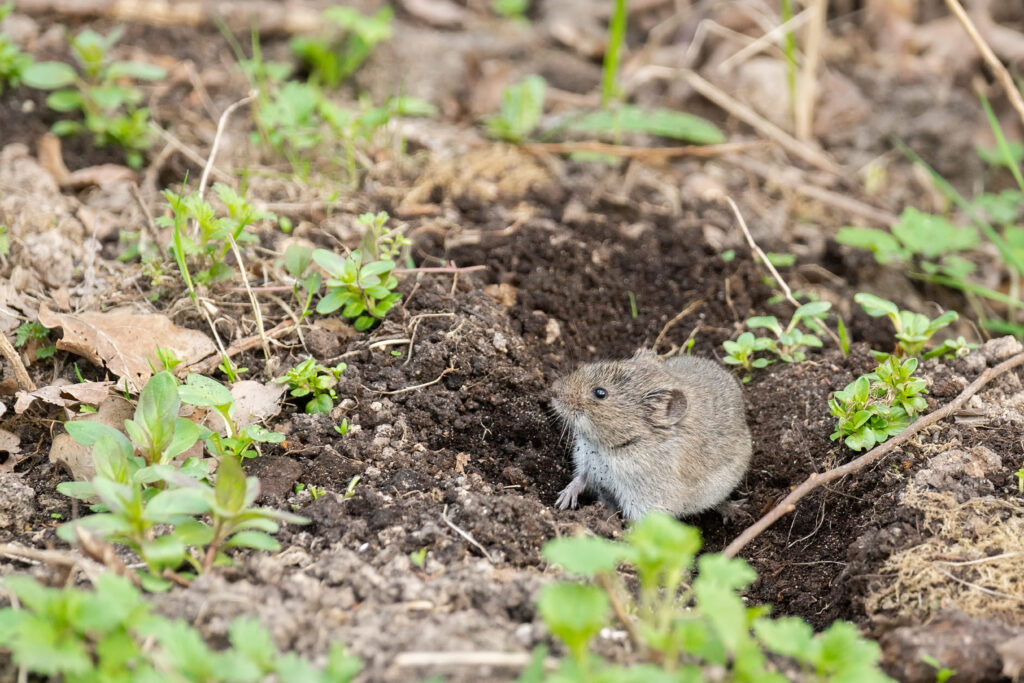
If you get a look at one, a vole is pudgy, with a blunt face, small eyes, tiny ears and a short tail. People call them meadow mice or field mice all the time, which doesn’t help. But they’re not the mice you find in the pantry.
What are the signs of pocket gophers?
Dirt mounds, mostly. According to CSU, pocket gopher mounds are fan-shaped to round, and the entrance is usually plugged, so you won’t see an open hole the way you would with a ground squirrel or prairie dog. One gopher lives per burrow, outside of breeding season, and they almost never come up top. So you’re reading their work, not watching them.
In spring there’s another tell. As the snow melts, you might find long ropes of packed soil lying on top of the lawn. CSU calls these eskers, and they’re left over from gophers burrowing up into the snow over the winter.
The plant damage is underground. Gophers cut through roots, so a plant that looked healthy yesterday can suddenly wilt for no obvious reason. Their tunnels usually run about 2 to 3.5 inches across and sit roughly 4 to 18 inches down.
Quick side note for the mountains. CSU says moles in Colorado are found only in certain parts of the eastern plains, so if you’re up in Teller County seeing tunnels and mounds, a mole isn’t the most likely answer.
How do you know if mice are the problem?
Inside the house? Then it’s mice. Voles and gophers stay outdoors. You’ll usually find the evidence somewhere you don’t look every day: the silverware drawer, behind the trash can under the sink, way at the back of the pantry where the cereal box has a corner chewed off. Shredded paper or insulation pulled into a nest somewhere quiet, a cabinet base, a box in the garage.
Up here the bigger concern is what they leave behind. Colorado’s health department says deer mice are the primary carrier of hantavirus in the state, and that people can get sick breathing dust stirred up from mouse urine and droppings. Which is why grabbing the broom or the shop vac is exactly the wrong move. Kicking that dust into the air is the whole problem. Open the doors and windows and let the place air out, Boulder County says give it 30 to 60 minutes. Gloves on, N95 on. Then soak everything, droppings, nest, all of it, in bleach and water or another disinfectant, and leave it sitting at least 10 minutes before you wipe it up wet.
If it’s a big mess in an attic or crawlspace, that’s a job worth handing off. We cover it on our Attic/Crawlspace Cleanout page.
What should you do once you know which one it is?
For mice, the real fix is keeping them out. We seal entry points with wire mesh, caulk, or expanding foam, and use live-capture traps and natural-ingredient repellents. There’s more in Rodent Prevention Colorado: Keeping Mice Out of Mountain Homes.
For voles and gophers, it starts with being sure what you’re dealing with, since the damage, the timing and the approach are different for each. In Colorado, CSU notes voles are classified as non-game wildlife and can be captured or killed when they’re causing property damage.
Not sure what you’re looking at? We’ll come take a look and give you an honest assessment. That’s what our Pest Inspections are for.
Frequently asked questions
What’s the difference between a vole and a mouse?
Voles are stockier, with blunt faces, tiny ears and short tails, and they live outside in grass runways. Mice are the ones that get into the house.
Do gopher mounds have a hole?
Usually not. Pocket gopher mounds are fan-shaped and the entrance is typically plugged.
Why does my lawn have trails in it after the snow melts?
That’s often vole runways, worn through the grass while they traveled under the snow all winter.
Is it safe to vacuum mouse droppings?
No. Colorado health officials say not to sweep or vacuum them. Ventilate, disinfect, let it soak for at least 10 minutes and clean it up wet.
Seeing mounds, trails, or droppings around Woodland Park, Colorado Springs or anywhere in Teller and El Paso County? Central Mountain Pest Control is family-owned, and estimates are free. Call us at 719-661-5310, check out our Pest Control and Wildlife Control services, read Pest Control in Woodland Park, CO: Managing Mountain Insects and Wildlife, or contact us


